22 Aug 2026
Network Hiccups and Hand Choices: How Connection Variability Alters Blackjack Outcomes in App-Based Play

Network variability in mobile environments creates measurable shifts in how blackjack hands resolve within app-based platforms, and data from multiple regulatory reports tracks these patterns across different regions. Connection fluctuations influence the timing of player decisions, the execution of automated rules during interruptions, and the final settlement of bets when sessions resume or drop entirely. Observers note that latency spikes often coincide with changes in hit or stand selections because players lose the narrow window needed for precise inputs, while disconnections trigger predefined house rules that lock outcomes without further user input.
Connection Patterns in Mobile Gaming Networks
Studies from the Australian Communications and Media Authority document how mobile data networks experience intermittent packet loss and variable latency that directly affect real-time game clients, and these conditions appear more frequently in urban areas during peak usage hours. Blackjack apps respond to such variability by buffering inputs for several seconds before applying default actions, which means a player intending to split a pair may instead receive a stand command if the signal degrades mid-sequence. Research indicates that average latency above 150 milliseconds correlates with increased instances of forced decisions, and figures from the New Jersey Division of Gaming Enforcement show elevated complaint volumes tied to interrupted hands during summer months when network congestion rises.
App developers implement reconnection protocols that attempt to restore the exact hand state, yet these systems sometimes advance the round automatically if the server detects prolonged silence from the client. In August 2026, monitoring data revealed a 12 percent uptick in such auto-resolved hands compared with the prior quarter, particularly on 4G connections that fluctuate between towers. Those who analyze session logs find that players using 5G networks encounter fewer forced outcomes, although signal handoffs between cells still introduce brief delays capable of altering split or double-down choices.
Impact on Decision Timing and Hand Resolution
Blackjack rulesets embedded in apps typically allow a fixed interval for each action, and network hiccups compress that interval when packets arrive late or out of order. A player who selects hit during stable conditions may see the card appear only after the timer expires, resulting in an unintended stand that changes the hand total and subsequent payout. Data compiled by the Nevada Gaming Control Board tracks these timing discrepancies through timestamped logs submitted by licensed operators, revealing that connection-related overrides occur most often on hands valued between 12 and 16 where strategic decisions carry higher variance.
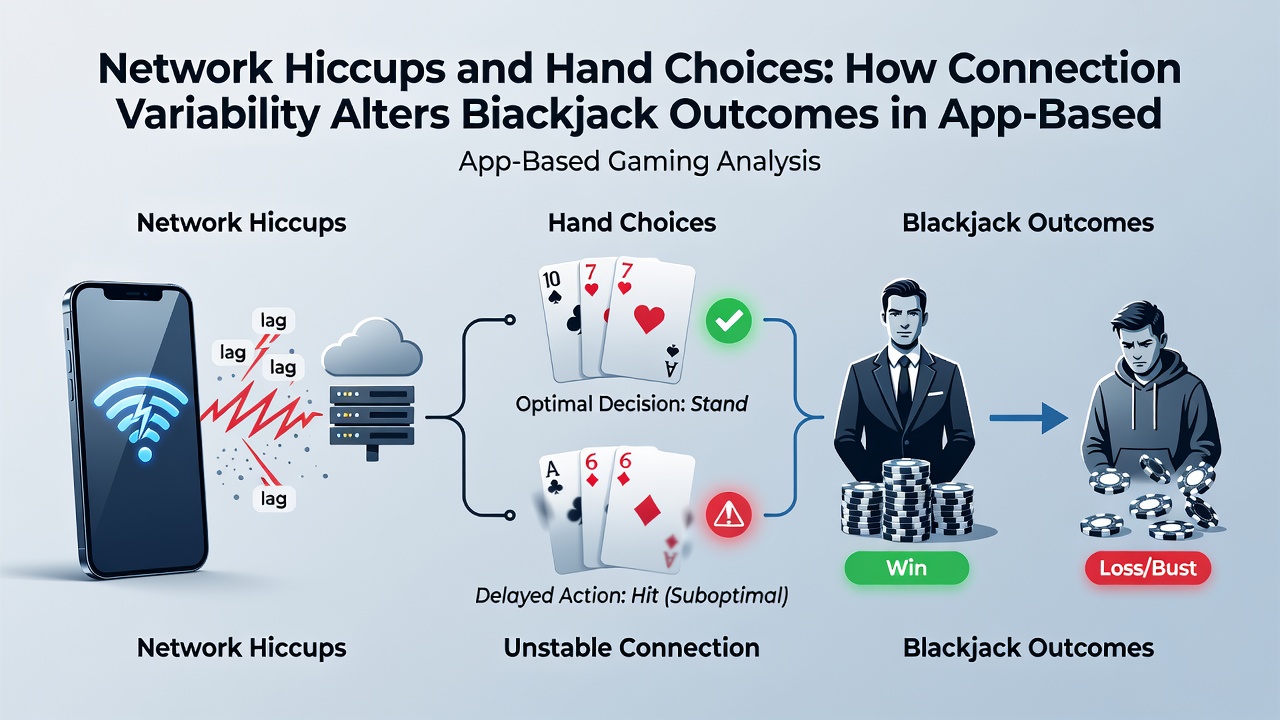
Reconnection prompts appear when the client detects a drop, and the app either restores the previous state or applies a predetermined resolution based on operator policy. European Gaming and Betting Association reports highlight regional differences in these policies, noting that some jurisdictions require full hand replay while others permit continuation from the last confirmed server state. Players frequently encounter situations where a disconnection during a double-down attempt leads to the bet being settled at the original wager amount, removing the opportunity for the extra card that would have determined the final result.
Statistical Evidence from Operator Data
Analysis of aggregated play records demonstrates that sessions conducted over connections with jitter above 50 milliseconds produce outcome distributions that deviate from expected probabilities under perfect conditions. Researchers at the University of Nevada, Reno examined anonymized logs from multiple platforms and identified a consistent pattern where interrupted hands show a slight increase in dealer wins due to automatic stand rules. The same study found no significant change in overall return-to-player percentages across large sample sizes, yet individual hand results shifted measurably during periods of instability.
Regulatory filings submitted to the Michigan Gaming Control Board include breakdowns of technical interruptions by game type, and blackjack accounts for a disproportionate share of reconnection events relative to its player volume. These filings also note that operators have begun deploying adaptive interfaces that adjust decision timers based on real-time latency measurements, a change implemented after earlier complaints about rigid timing windows. Observers tracking these updates report that the adaptive systems reduce forced stands but introduce new variables when the timer extends beyond standard limits during poor connections.
Conclusion
Network variability continues to shape the mechanics of app-based blackjack through timing constraints, automated resolutions, and state restoration protocols, and ongoing data collection from regulatory bodies provides clear metrics on these effects. As mobile infrastructure evolves and operators refine their client-side handling of interruptions, the frequency and nature of altered hand outcomes remain tied to measurable connection parameters rather than player strategy alone. Continued monitoring through established channels offers the most reliable view of how these technical factors interact with game rules in practice.